
Searching Lauderdale County Criminal Dockets
Begin at the court that owns the case. For a known Circuit or District Court date, the free Lauderdale Search Docket is the quickest tool. Pick a setting date. Add a last name only if you need to narrow things down. Leaving that field blank pulls the full published list for the date. The form itself warns that some cases may not appear. A missing result never proves a criminal case does not exist.
Need more than a date? Alacourt ACCESS, also called Just One Look offers paid statewide searches by name or case number, covering criminal and other Alabama trial-court records. Each search costs $9.99 and includes one case detail. Verify the spelling and the court before you pay. Pulling another detail means a second charge.
- Decide whether the charge is in Circuit, District, or a municipal court.
- Use the free date list for a setting, or Just One Look for a case detail.
- Open the Case Action Summary and match the court, party, and case number.
- Read charges count by count, then check the newest setting and disposition entries.
- Call or visit the Circuit Clerk when a record is absent, unclear, restricted, or needed as a certified copy.
Lauderdale Criminal Docket Path
One felony can leave footprints at two court levels. Arrest, bond, initial appearance, and preliminary hearing often start in Lauderdale County District Court. A grand jury indictment changes things. A fresh Lauderdale County Circuit Court criminal case takes over arraignment, motions, plea or trial, judgment, and sentencing. The identifiers can change at each stage even though the incident stays the same.
State misdemeanors usually stay in District Court. A city ordinance charge or municipal misdemeanor belongs to the municipal clerk who opened it. That split is why a statewide name search may not answer a city-case question. Use the court printed on the summons or notice. Then follow any transfer or appeal entry rather than assuming one screen holds the whole path.
Typical felony path: District filing › preliminary and bond events › grand-jury indictment › Circuit arraignment › pretrial › plea or trial › judgment and sentence.
Inside a Lauderdale County Criminal Docket
Think of the Case Action Summary as a timeline in rows. It lists the court and case. The rows also name the prosecuting party, the defendant, counsel, charges, settings, rulings, costs, and the recorded outcome. The blank Alabama criminal Case Action Summary, Form C-6 also reveals the state's own vocabulary for bond, preliminary hearing, warrant or capias dates, jury status, classification, judge identification, and repeated action rows. What the form collects is not a promise. Not every sensitive item reaches a remote public report.
| Case Number | The court's unique identifier. Use the exact number shown rather than assuming an unpublished local pattern. |
|---|---|
| Charge | The offense and classification when entered. An accusation or indictment is not a conviction. |
| Bond or Capias | Release data or a court command related to custody. A bond amount is not a fine. |
| Setting | An arraignment, motion hearing, pretrial conference, plea, trial, sentencing, or review date. |
| Action or Ruling | A dated entry that may index a filing, notice, motion, order, or judgment. |
| Disposition | The outcome tied to a case or charge. The word “disposed” alone does not state which outcome occurred. |
Read the entries oldest to newest to understand the sequence. Then work backward from the latest setting to find the current court date. When exact sentence terms or the reasons behind a ruling matter, get the judgment or order behind the summary entry.
Read Lauderdale Criminal Charges Carefully
A Lauderdale County criminal docket may hold several counts. Match every plea and ruling to its own charge. One count can be dismissed while another ends in a judgment, so a case-level status can hide that split. "Nolle prosequi" means the prosecution formally chose not to continue a charge under the applicable procedure. "Acquitted" records a not-guilty outcome. Neither word means expungement.
- Arraignment
- The stage when the charge and plea are addressed.
- Indictment
- A grand-jury charging document that moves a felony into Circuit Court.
- Continuance
- An order moving a setting to a later date.
- Disposition
- The recorded result of a case or an individual charge.
- Certified copy
- A reproduction authenticated by the clerk, unlike an ordinary portal printout.
A motion entry only proves a request reached the file. It says nothing about whether the judge granted it, so look for a later order and read the linked image if available.
How a Criminal Case Moves
Criminal events run in sequence, but the route depends on the offense and the court. A District Court misdemeanor skips the indictment step a Circuit felony requires. A municipal prosecution stays with its city clerk. An appeal opens a new Circuit Court record. Read the docket as a trail of filed acts, never as a prediction of what comes next.
Docket flow: Filing › Arraignment › Pretrial › Plea or Trial › Disposition › Sentencing.
Later entries may show post-judgment motions, a notice of appeal, record transmission, or remand. Criminal appeals from Lauderdale County can proceed to the Alabama Court of Criminal Appeals, with further review governed by Alabama law and court rules. An appeal entry never erases the trial-court history.
Lauderdale Criminal Docket Judges
The official Lauderdale County Circuit judges page identifies the judges and chambers serving the county's Circuit Court. Treat it as a court directory; the Circuit Clerk remains the records contact.
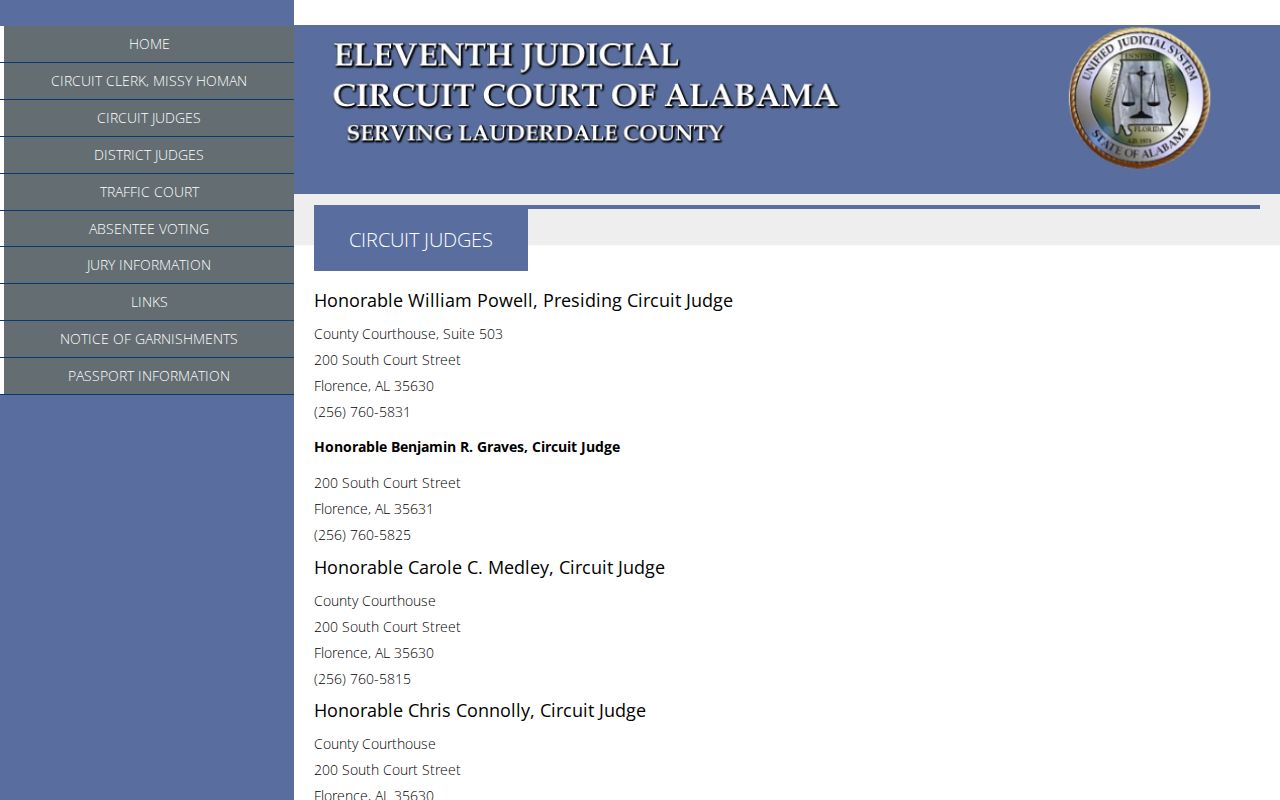
The directory helps confirm the court listed on a setting. Still, send requests for a Lauderdale County criminal docket, filed order, or certified judgment to the Circuit Clerk. Do not go to a judge's chambers.
Lauderdale County makes up the entire 11th Judicial Circuit. Circuit Clerk Missy Homan is the official record keeper for both Circuit and District Court proceedings. Divisions cover Criminal, Warrants, Traffic, and other trial-court record areas. That unified office clears up a common point of confusion. Municipal criminal files stay with their city clerks.
Assignments can shift as a case moves. Trust the current docket or notice for the assigned court over any old directory entry.
Courts That Hold Criminal Dockets
Lauderdale County splits its criminal docket between two courts. Circuit Court takes felonies once a grand jury indicts. It handles some appeals as well. District Court covers state misdemeanors, warrants, preliminary felony hearings, and similar settings. One office serves both: the Circuit Clerk at 200 South Court Street in Florence. Call 256-760-5728 for records help. The counter is open weekdays from 8:00 a.m. to 5:00 p.m.
Municipal courts work differently. They handle ordinance violations and city misdemeanors. Each has its own clerk, so those court records sit outside the county clerk's files. Free public terminals are another option. The Alabama Rules of Court-Record Privacy and Confidentiality let visitors view electronic Circuit and District dockets and filed records at the courthouse during regular hours, within stated limits. Lauderdale has not said where the workstation sits. Phone ahead if you need an office terminal.
Lauderdale Criminal Docket Access
Remote tools and the clerk's counter fill different needs in a Lauderdale County docket search. Just One Look sells case details, actions, settings, financial data, and any available images. Alacourt.com runs on subscription and is read-only. AlaFile handles filing and electronic service rather than ordinary public reading. The county's free date list can confirm a published setting. It expressly may omit cases, though.
At the counter, ask to inspect a file. You can get a plain or certified copy, or pull an archived one. Phone confirmation works too: 256-760-5728. Mail requests go to Circuit Clerk, P.O. Box 776, Florence, AL 35631. Lauderdale has published no fixed criminal-copy form or turnaround time. So settle prepayment, postage, and return-envelope terms before you mail anything. Direct any formal court-record request to the judicial office that actually holds the file.
Costs follow Rule 30, which lets the clerk require a written request and advance payment. The official local chart sets $0.25 per page for fewer than 20 pages. It charges $0.50 per page under its over-20-page wording. A $5 certification charge also applies. Ask the clerk how the page threshold and certification apply to your document.
Lauderdale Specialty Criminal Dockets
The current Alabama adult drug court map lists Lauderdale as operating an adult drug court. An official 2009 report shows the program existed by then. The county publishes no separate public calendar. It offers no coordinator page, no local eligibility rules, and no stand-alone search portal.
So search the underlying Circuit or District criminal case instead. A Case Action Summary may track court events. Treatment assessments and protected program details can stay confidential. An ordinary criminal docket label alone never proves participation. Confirm settings with the Circuit Clerk. Rely only on a program contact supplied in the case itself.
Note: A specialty track does not place confidential treatment material into the public Lauderdale County criminal docket.
Sealed Dockets and Public Access
Most ordinary case-index information is open. Paying a fee changes nothing about a restriction, though. Juvenile matters, youthful-offenger material, sealed records, expunged records, and other protected information may be omitted or limited. That can happen in any Lauderdale County docket search. A missing web result can also mean the wrong court. Stale data, a transfer, delayed posting, or a misspelled name can all be the cause. Contact the responsible clerk rather than trying to work around an access limit.
Alabama access rules:
Rules of Court-Record Privacy and Confidentiality presume access unless law, rule, or court order restricts it and require specific findings for sealing.
Rule 30 of the Alabama Rules of Judicial Administration governs clerk copies and certification.
Rule 33 of the Alabama Rules of Judicial Administration preserves clerk-office inspection while AOC controls remote electronic access.
For a case you know is restricted, give the case number and state the authority under which you seek access. The clerk cannot give legal advice. Only the controlling law or a court order can open nonpublic court records.